
The AI boom has created an immense divide in technology markets. A handful of mega-cap winners have attracted enormous amounts of capital, while profitable software businesses have been taken to the woodshed.
That's happened in Japan too, creating an opportunity investors largely overlooked, especially given the country's severe labour shortages and lagging digital transformation.
The TOPIX is up almost 35% over the past year to 30 June 2026, and the Nikkei 225 almost 60% over the same period, driven by exporters, banks, semiconductors and other large companies. For a good chunk of that period, small and mid-cap software has gone the other way. The MSCI Japan Software & Services Index fell around 35% between January and June 2026, despite little change in the underlying businesses.
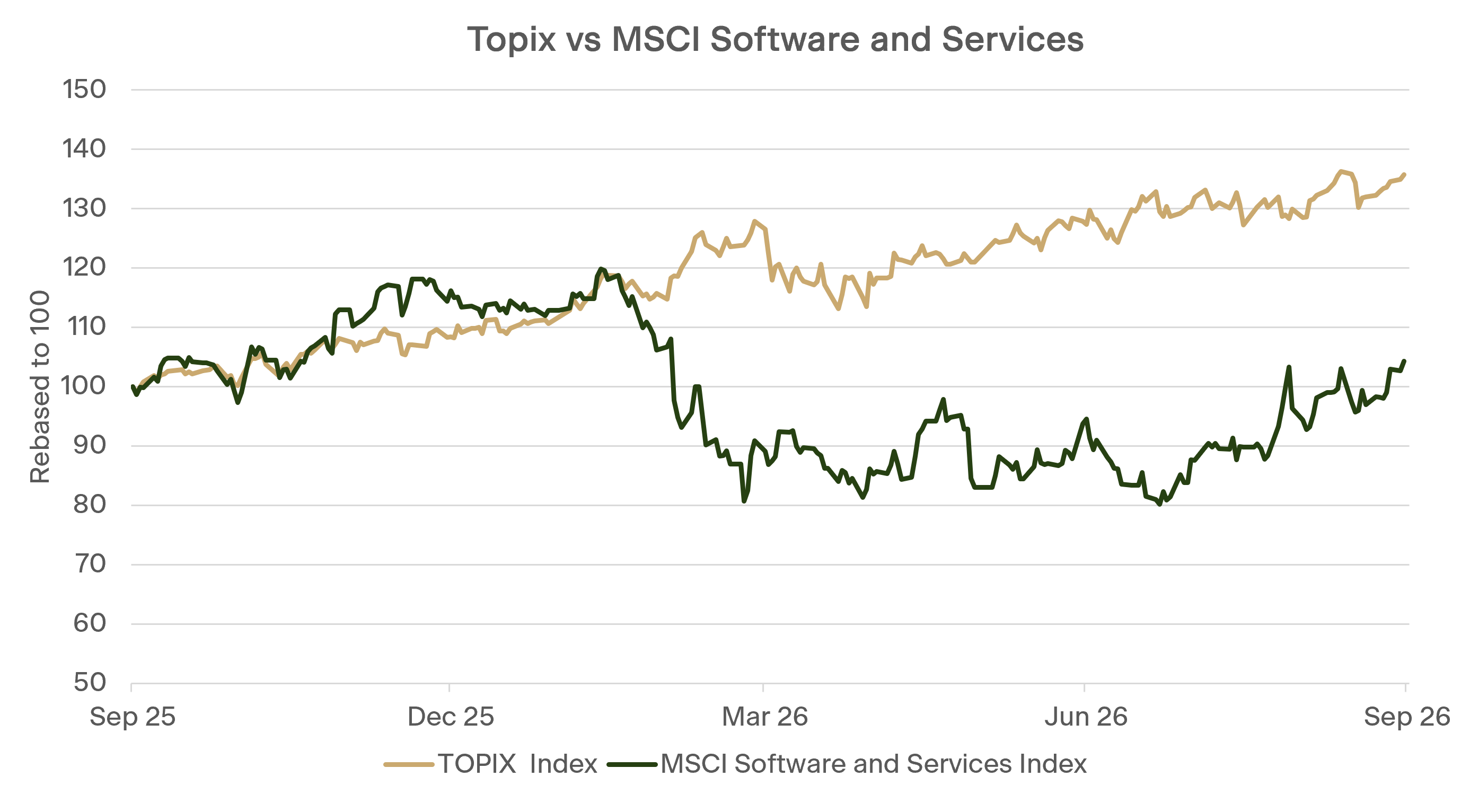
Source: Bloomberg
Past performance is not indicative of future performance and the value of your investment can rise or fall
That's the corner of the market we've been focused on. The Fund already owned some of these stocks going into the sell-off. Each quarterly report over that time showed businesses that were continuing to grow, while their share prices collapsed. So we bought more. The Japanese weighting in the Forager International Shares Fund has gone from around 5% a few years back to 18% today, mostly invested in small and mid-cap software and IT consulting companies.
The bit of Japan we own isn't driving the index higher. It’s still cheap.
Guilty by association
The reason for the sell-off is familiar: investors fear AI will make traditional software obsolete.
But where’s the evidence? We've seen similar cases in the US and UK where companies such as Salesforce (NYSE:CRM), Atlassian (NASDAQ:TEAM) and Sage Group (LSE:SGE) were sold off 40-50%. And then strong results reminded investors that good software businesses remain valuable. Atlassian has surged more than 70% over the month of July on strong earnings.
Japan has seen similar volatility. OBIC Business Consultants (TSE:4709) (OBC) offers accounting and payroll software - like Xero (ASX:XRO) does here in Australia. But OBC tends to sell to somewhat larger businesses with more complex compliance needs. OBC spent years moving customers from desktop software to subscription-based cloud software, the same shift Xero made in Australia a decade ago. It now has a leading position in its market, customer retention above 99%, and exceptionally high margins.
OBC’s stock is also dramatically cheaper than Xero’s. Xero trades at more than 50 times next year's expected profit. OBC trades at about half that multiple. It also has cash in the bank worth almost a quarter of its market capitalisation.
Then the numbers landed
OBC's June-quarter result provided a useful test of the AI-disruption thesis.
Revenue grew almost 14%, cloud revenue more than 25%, and profit grew faster than revenue. The company retained 47 cents of every dollar of revenue as profit, the kind of operating margins most ASX-listed tech companies could only dream of.
Perhaps more importantly, OBC announced its first-ever price increase on its core cloud products, of roughly 15%. Pricing power is one of the clearest signs that a software business isn't being commoditised. OBC is raising prices on essential products used for accounting, payroll and tax compliance. Accounting and tax software needs constant, precise regulatory updates, exactly the kind of "boring but essential" software that's hard for a generic AI tool to replace anytime soon.
The increase also creates potential upside to earnings. It isn't included in the company's existing guidance, and the rollout is staged to reduce customer disruption. New customers pay the higher price from October, existing customers face the increase at renewal from January 2027, and legacy on-premise customers that migrate to the cloud before the end of 2026 can lock in today's pricing for a year. It’s a neat incentive to accelerate the cloud transition.
Investors noticed. OBC shares jumped almost 9% after the announcement and are now roughly 45% above their mid-June lows.
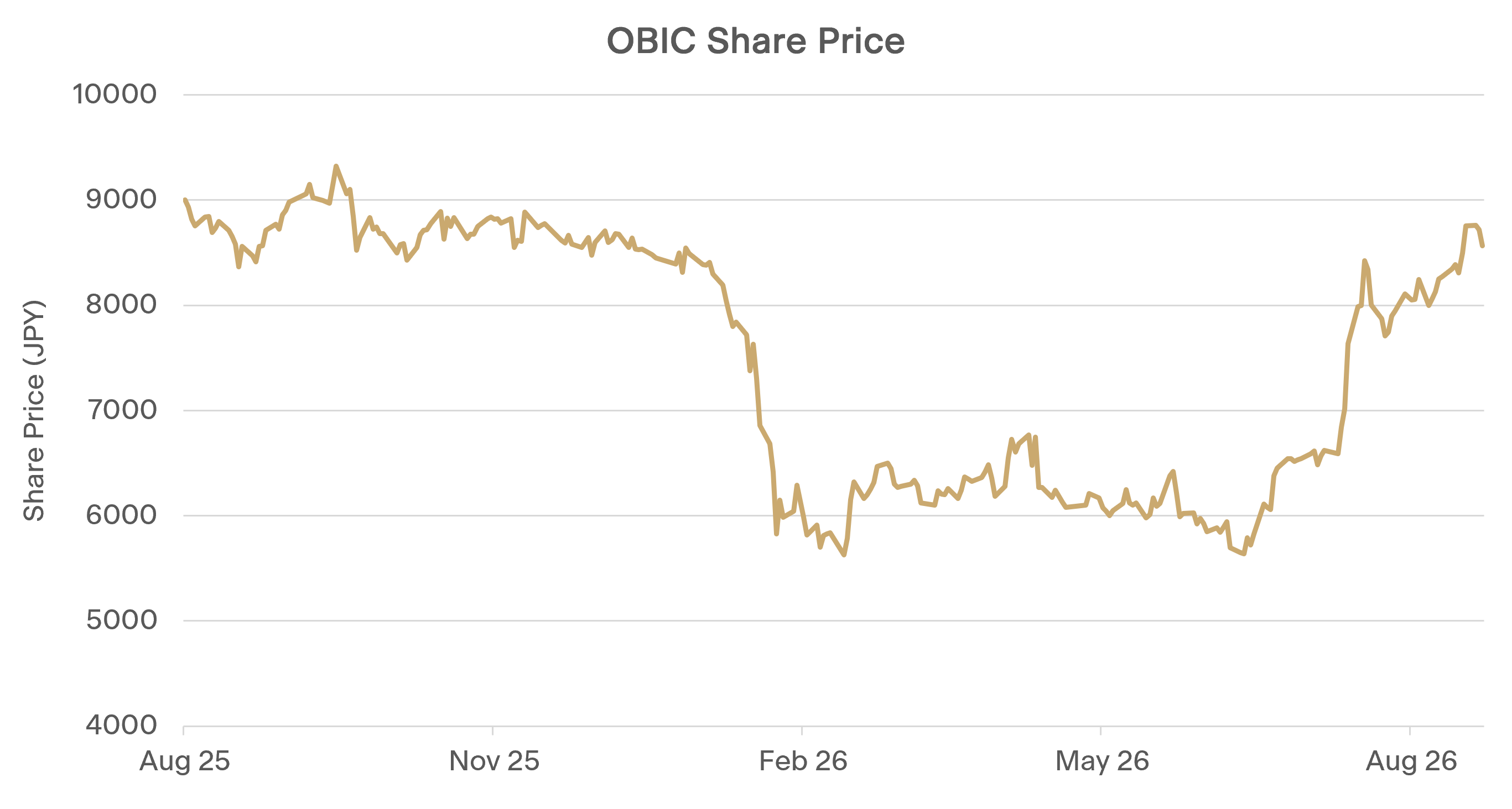
Source: Bloomberg
Past performance is not indicative of future performance and the value of your investment can rise or fall
The business didn't suddenly become better. Immense pessimism over the prior few months lifted as the underlying business continued to deliver.
The bigger opportunity
Software stocks globally have been hit through 2025 and into this year, Japan is simply one of the more extreme, lesser-followed pockets of a broader mispricing.
The Fund has increased exposure a lot outside of Japan too. UK-listed Sage Group is an accounting software business similar to OBC and Xero, but with a US, UK and European customer base. Its stock fell more than 40% from its high in 2025 to its low in February 2026, the same month the International Fund bought both its first shares and took the majority of its current position. The company has continued delivering operationally and the stock is up more than 35% from that low. It’s the Fund’s largest holding presently.
We hold US-listed software to a higher bar given our ongoing concerns around rampant share-based compensation. But we added Wix.com (NASDAQ:WIX) to the portfolio at the beginning of July, and its share price is up 50% since then and 80% off its June low. Bearish sentiment had hammered Wix.com on fears that generative AI would make traditional web-builders obsolete. Instead, the latest results revealed 15% annual recurring revenue growth, and strong adoption of its Base44 apps show Wix expanding into complex application development rather than being displaced by it.
The Saaspocalypse felt overblown, we moved accordingly, and the evidence so far has been encouraging. There's no signs of customers walking away for an AI alternative. Software companies are, understandably, racing to make AI a feature - turning the "threat" into a retention tool. The US software index, the IGV, has rebounded 35% off its bottom and is back within 10-15% of its highs. There are still good opportunities out there, but the market has moved quickly.
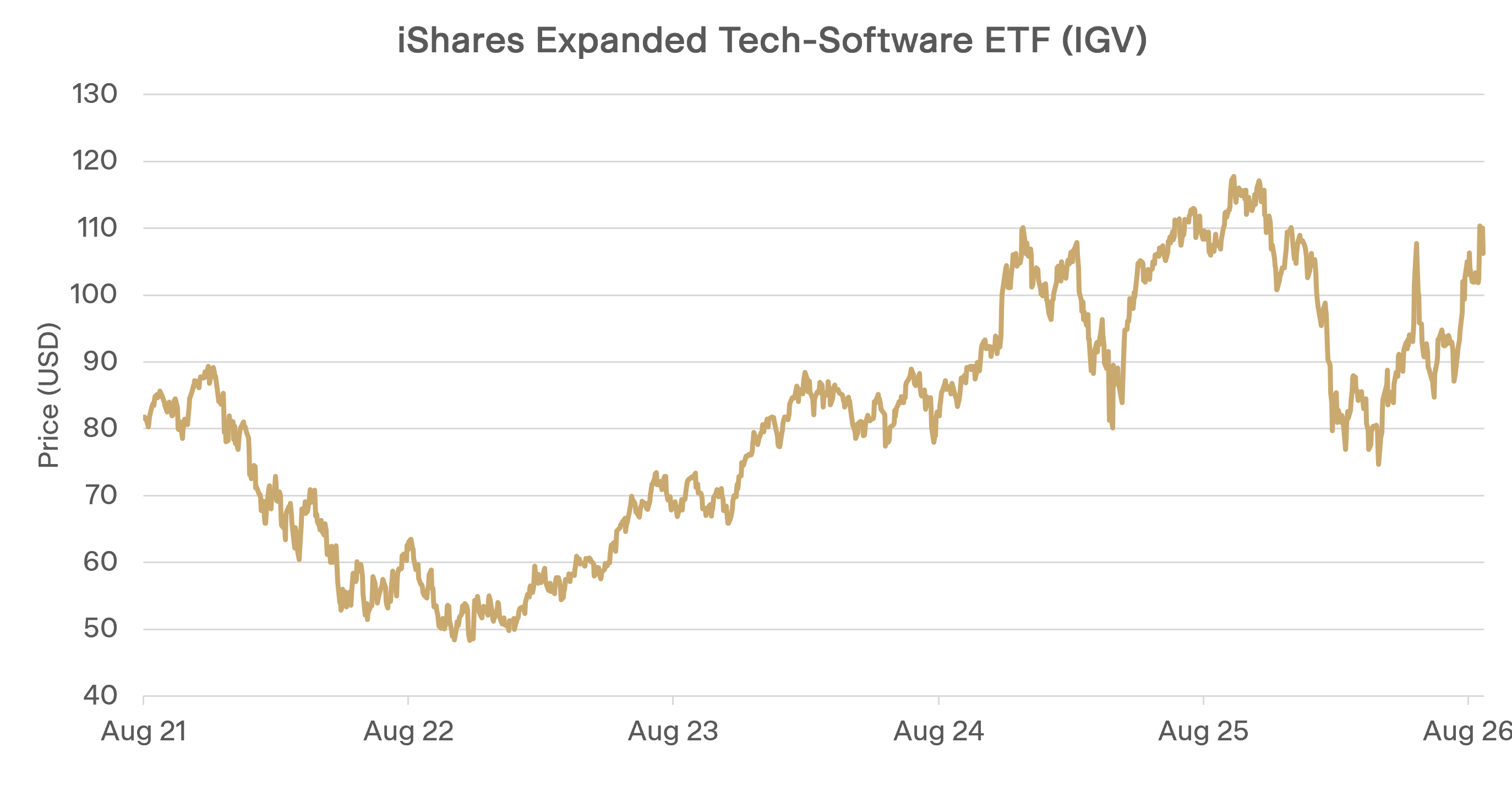
Source: Bloomberg
Past performance is not indicative of future performance and the value of your investment can rise or fall
We may still be wrong. No single result can disprove the idea that software is dying. But with each impressive quarterly result, each uptick in customer numbers and pricing, the onus increasingly shifts to the bears to explain why software is doomed.
*The above article represents Forager’s internal investment views only and should not be considered a recommendation to buy, sell or hold any security.