
After months of headlines declaring that artificial intelligence (AI) would dismantle the software-as-a-service (SaaS) model, updates from several high-quality local software companies this week told a different story. Rather than collapsing under the weight of AI disruption, parts of the sector delivered accelerating growth and upgraded guidance.
TechnologyOne (ASX:TNE), a provider of software to government and education organisations in Australia and the UK, upgraded guidance for profit before tax growth to 18-20%. While Hansen (ASX:HSN), a global software provider to utilities and telco companies, delivered 16% recurring revenue growth and confirmed expected growth and margin over the next few years. Investment platform Netwealth (ASX:NWL) delivered better flows and a solid profit result. Each of the stocks duly rallied.
Given how front of mind it has been for investors, each also explained management’s view on whether AI is a friend or foe.
The existential fear is straightforward. AI is dramatically reducing the cost of developing software. Clients will vibe-code their own solutions for next to nothing. And AI native competitors will proliferate.
TechnologyOne’s response is that resilience depends on the type of software provided. It operates mission-critical software systems in highly regulated environments. These need to be unquestioningly reliable, have the highest levels of cyber protection, and are provided to many users and parts of an organisation.
A treasure-trove of data, deep domain expertise, switching costs and outcome-linked pricing are key defences. The company has 38 years of data, 99% client retention, and long-term contracted clients. “Plus”, the company’s agentic AI platform, is embedded across products and modules, operating within each customer’s trusted environment.
Hansen makes a similar case. Its systems are deeply integrated in complex utility and telco organisations, are highly regulated and difficult to replace. They require almost perfect uptime. Understandably customers are highly risk averse. Customer trust has been earned over decades. And AI is already embedded across the product suite, driving some short term power trading decisions, talking to customers and explaining bills.
Netwealth recognises the pace of innovation will increase. Luckily, the business, alongside other challengers like Hub24 (ASX:HUB) and Praemium (ASX:PPS), are no strangers to innovation. These specialist investment platform providers have attracted advisors by offering better systems, and are likely to continue to do so. There is no shortage of opportunities to add new features and improve advisor efficiency. Scale, regulatory moats and data quality are difficult to replicate. Revenue is linked to funds and transactions rather than seats.
Across all three businesses, common themes emerge.
There will be casualties. AI will put genuine pressure on commodity software providers with limited switching costs. But it looks likely to strengthen mission-critical, deeply embedded systems that have data, workflow and compliance advantages.
If trusted providers with sticky software can deliver advanced AI features, sophisticated clients are unlikely to take a chance on new competitors and run the risk of implementation, training and reliability issues.
From defence to offence
For incumbent software providers, AI functionality is not simply a defensive feature. Instead of shrinking revenue pools, AI can expand them.
When AI improves workflow speed, reduces manual processing or enhances decision quality, the value delivered to the client is tangible. Pricing to customers can then rise to capture the added value. For software businesses already deeply integrated into client operations, AI becomes an upsell opportunity rather than a competitive threat.
Then there are the potential cost reductions for software providers. AI-assisted coding, automated testing and faster product configuration shorten development cycles and reduce the number of software engineers required. Customer service chatbots and agentic support systems lower call centre workloads while maintaining service quality. The business can bank the savings or reinvest them elsewhere.
One banking the savings is investment platform operator Praemium. The business announced a major overhaul of its technology division earlier this week, coming on the back of an acquisition of consultancy Technotia announced in December for $7.5m. The restructure targets duplicate IT development, maintenance and infrastructure roles and represents a meaningful reshaping of the company’s cost base.
Headcount in Australia will fall, and a longstanding Armenian software development operation will close by the end of this financial year. In total, headcount will reduce by 28% and run rate cash costs will drop by $9m. The financial implications are material; free cash flow next financial year should improve by roughly 30%. AI was not specifically cited in the announcement, but would have been helpful in making such significant changes.
Perspective in the panic
The nuance has been lost in the sell-off. Late last year Australian technology valuations were at their highest levels since 2021. Having fallen more than 30%, they are now trading at levels last approaching COVID lows.
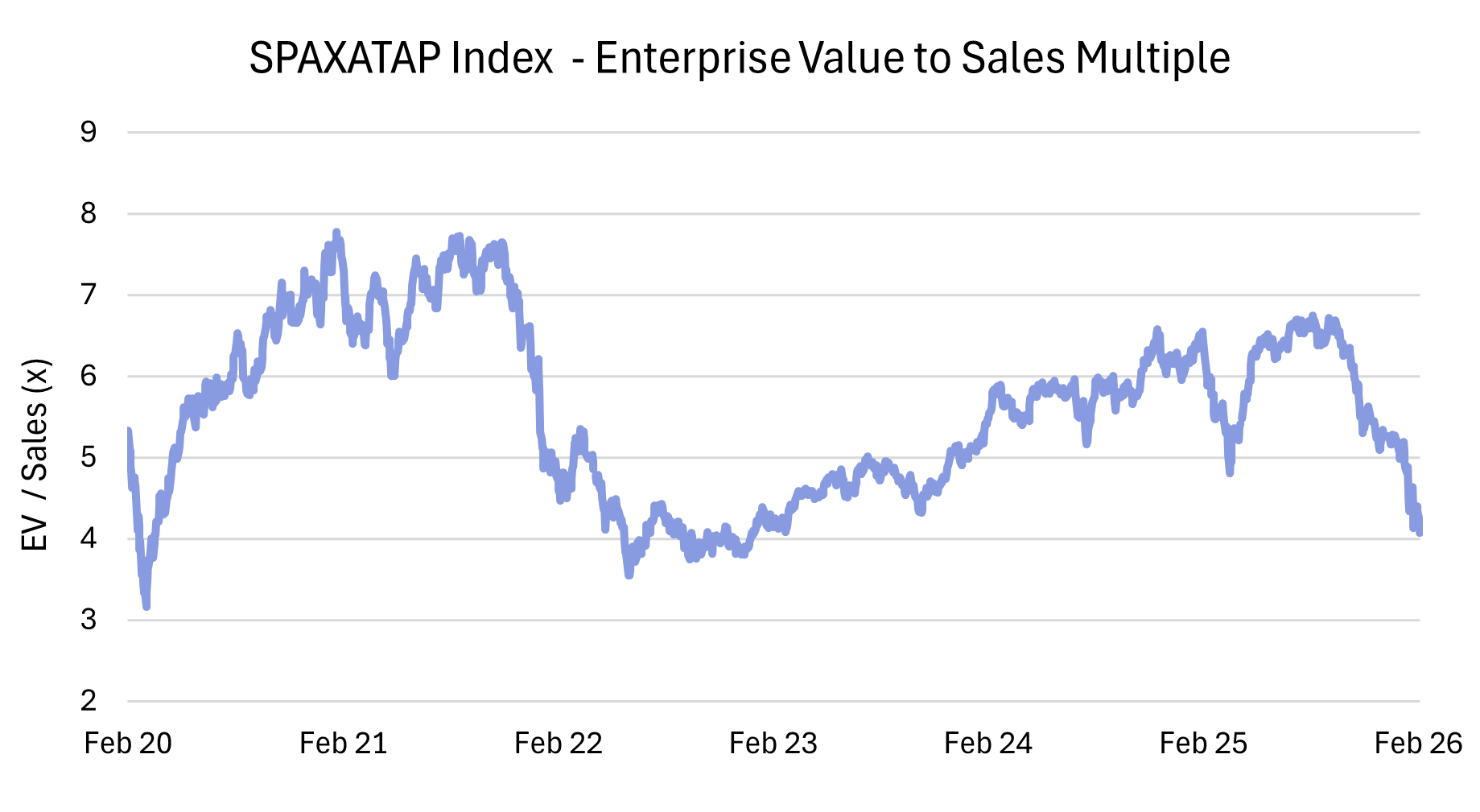
Source : Bloomberg
The narrative shift has been swift, and markets have rarely been patient in periods of technological change. But narratives change. Over the next year or two we may see investors focus more on the strength of incumbents, and their ability to reduce costs while growing pricing. In that world beaten down software businesses could well be back in vogue.
In the Forager Australian Shares Fund, the pessimism has created opportunity. After exiting both last year, investments in sports technology provider Catapult (ASX:CAT) and financial services software business Bravura (ASX:BVS) have been added back into the portfolio as stock prices fell sharply and valuations became attractive. Both operate highly sticky mission-critical software in specialist verticals where data and knowhow matters, and where AI can improve cost efficiency while improving the product.
SaaS is not dead. Reporting season suggests that high-quality, mission-critical technology businesses are adapting quickly. The Saaspocalypse may well end up being a SaaSvolution as software providers continue to evolve and grow.
If you're interested in joining our investing community, you can do so by filling in the form below: